
On a beautiful Saturday morning, seventy local residents and visitors gathered for the fifth anniversary walk of the Trust’s popular and now traditional annual event.
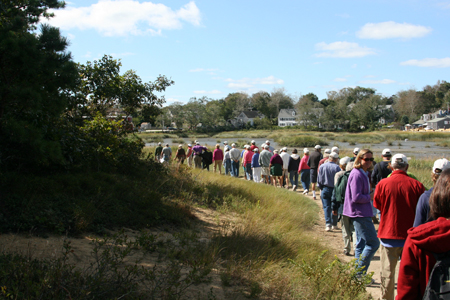 Starting from the Congregational Church, where Trust President Denny O’Connell noted the steeple clock strikes the hours in eight bells–the only church in the country that continues this early American coastal town tradition–we proceeded to Dr. Clarence J. Bell Square at the corner of Main street and Whit’s Lane. There Trustee Marcia Seeler spoke about the early century significance of the site, dedicated in 1982 to the memory of Dr. Bell, a family physician whose home and office were at that location.
At Uncle Tim’s Bridge we heard an informative talk on the ecology of the Duck Creek tidal marsh by Bob Prescott, Director of Massachusetts Audubon’s Wellfleet Bay Wildlife Sanctuary. Janet Erickson then spoke about the history and reconstruction of Uncle Tim’s Bridge, a local historic landmark named after Timothy A. Daniels who died in 1893. Trustee Frank Corbin then led the walkers around Hamblen Park, also known as Cannon Hill where he described plans to rectify serious erosion on the south slope facing the marina, clear underbrush and improve the vistas from this popular walking area.
 Denny O’Connell then led the group along the shore of Duck Creek to the Trust’s most recent acquisition, a one acre former residential property behind the Mobil Station on Route 6. He spoke about how the Trust is dedicated to preserving land such as this for generations to come. There’s a story elsewhere in this newsletter about the property. We then circled back along the railroad dike to where the former bridge crossed Duck Creek. There local historian and author David Wright talked about the history of the town along Commercial Street and the role the early railroad played in tourism and the commercial shellfish industry of Wellfleet.
Over the past five years we have visited a different area of our town in places that you may not normally visit and always with individuals who could speak with knowledge about the history and significance of the area. The first walk, in 2007, covered Griffin Island, followed in 2008 by an exploration of Bound Brook Island. In 2009 we walked through the National Seashore where Henry David Thoreau walked over 150 years ago with a stop by the Oysterman’s home where he stayed. In 2010, starting at the Fox Island Marsh and Pilgrim Spring Woodlands Conservation Area we walked along the shoreline of Blackfish Creek and Drummer Cove ending at the Pond Hill School in South Wellfleet.
We’re already thinking about the 2012 walk–any suggestions? And please plan to join us next September.
 The walk took place with about 40 walkers – fortunately after the rain at 4 am this morning and before the rain at 2 pm this afternoon. A great day – in addition to the three mile walk, John Portnoy spoke on the geology of the Cape and the origin of the ponds, Jeff Hughes, Wellfleet Herring Warden spoke at Herring Pond on the life cycle of herring and Ginie Page read from
 Thoreau’s book when he visited the Oysterman’s House on Williams Pond. A terrific day. Hope you’ll join us next year.
 On an overcast, and sometimes drizzling Saturday morning, over fifty walkers gathered at the Atwood Higgins House on Bound Brook Island to participate in the second annual Wellfleet Conservation Trust “Walks in Wellfleet.”
 On Sunday, September 16, 2007, seventy five individuals participated in the first annual “Walks in Wellfleet” sponsored by the Trust in cooperation with the Cape Cod National Seashore, Herring River Restoration Project and the Town Open Space Committee. There were four walk options available ranging from one mile to three and three quarter miles along different paths throughout Griffin Island, Wellfleet.
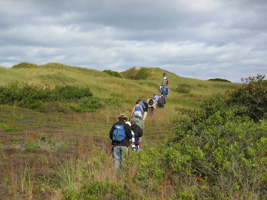 But this was more than just walks over the dunes and through the woods. Following a brief orientation by Denny O’Connell, Trust President, three highly professional and knowledgeable National Seashore ecologists, John Portnoy, Stephen Smith and Evan Gwilliam each led walkers through different areas of Griffin Island and gave presentations along the way on the Herring River Restoration Project, cultural landscape restoration, upland plant and marsh ecology, and the historical development of the land.
 At right shows the 181 acre conservation area that has been preserved through the efforts of the Town of Wellfleet, the State Fish and Game Department and the Wellfleet Conservation Trust since 1992. It is the largest publicly-accessible conservation area on the Outer Cape outside of the National Seashore.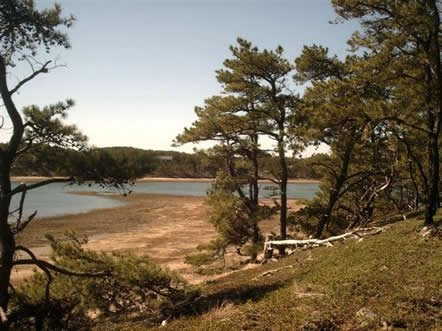


 Wellfleet Conservation Trust
You must be logged in to post a comment.