First Day Walk: The Gut to the Herring River Overlook

Report by Bill Iacuessa.

Thirty-eight participants thoroughly enjoyed the First Day Walk 2024, The Gut to the Herring River Overlook. Bright skies greeted the walkers as they arrived at the National Seashore Great Island parking lot. Bill Iacuessa, Vice-President of the Wellfleet Conservation Trust (WCT), welcomed the participants and described the walk saying that the Trust and the Friends of the Herring River (FHR) were delighted at the turnout. Dale Rheault, Chair of the Friends of the Herring River, was introduced, and spoke briefly about the role of the FHR. Speakers Alice Iacuessa and John Portnoy were introduced. Alice and John, are former members of the FHR board and along with Barbara Brennessel, co-authors of Tidal Waters, A History of Wellfleet’s Herring River.

The walk began by heading down the hill to the beach near the mouth of the Herring River and the Gut. Bill gave a short orientation, and then Alice talked about the recent archeological research on Native American and English colonial use of Great Island. The walk proceeded down the beach a bit further toward the dike where John talked about the history of the dike and benefits of removing it which will restore the salt marsh incrementally over a number of years.

The walk proceeded up to Chequessett Neck Road and crossed over the dike. Although not open yet, the completed temporary bridge was in full view of the walkers. Continuing along the participants reached the parking lot of the Herring River Overlook Conservation Area where Denny O’Connell, President of WCT met them. Denny described the acquisition of the 18-acre parcel, the significance of its location, and the creation of the one-mile trail. The walk continued with short stops where Denny pointing out features, the most significant being the views of the Herring River from above.

The walkers retraced their steps. Just before the parking lot, at the gravesite of a Native American woman, Alice talked about how and why it was placed at this location. The two-mile, two-hour walk concluded at noon.

Photos, taken by Dwight Estey, board member and former president of the Wellfleet Historical Society and Museum, can be viewed at WCT-FHR – First Day Walk – 2024.

Maintaining trails

A friend commented that he had done a lot of hiking and walking on nature trails, but that he’d only recently become aware of the many decisions and the work it took to build and maintain a trail. He would be interested to see what we do with Wellfleet Conservation Trust trails.

Protecting the site

We plan these trails to entail minimal destruction to the environment. They should be obvious so that walkers can stay on them without creating social trails through the woods. But we like them to be as unobtrusive as possible. This requires a balance of engineered and natural features.

Among other things, we cut overhanging branches that pose a hazard to walkers, but leave any vegetation higher than a Celtics player, unless it’s in danger of falling. We make the trail wide enough for anyone to walk easily, but usually require a single file. We place trail blaze arrows at confusing junctions, but try not to use more than absolutely necessary.

Visitors from Nepal helping to repair a roped off area at Herring River Overlook

In some places we’ve added stakes and ropes to discourage off trail walking. As enticing as that bushwhacking may be for some, it can be very destructive for the land. For example, at the Herring River Overlook trail, walking down the dune towards the river kills fragile lichen, moss, bearberry, mayapple, violets, sea oats, and other vegetation. That in turn can lead to serious dune erosion.

The ropes are easily bypassed, but we don’t want to mar the sites with massive barriers. We have to trust that responsible visitors will recognize the message and stay on the trail.

National Park Service plea, too often ignored

In many parks today we see the sign that “vegetation grows by the inch but dies by the foot.” That’s especially true on Cape Cod. Tenacious plants can survive despite salty winds off the sea, sandy, nutrient poor soil, and hungry wildlife, but only if we’re on their side.

Herring River Overlook work party

Our newest WCT conservation area, now dubbed Herring River Overlook (HRO), offers woodlands, wetlands, meadows, and incredible views of the Herring River estuary.

As the Herring River restoration project proceeds, these views will become even better. They’ll provide a tutorial on the restoration of the historic salt marsh, with its diverse flora and fauna.

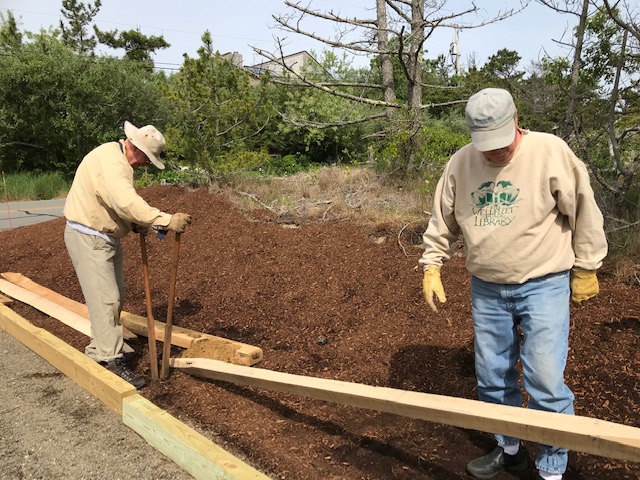
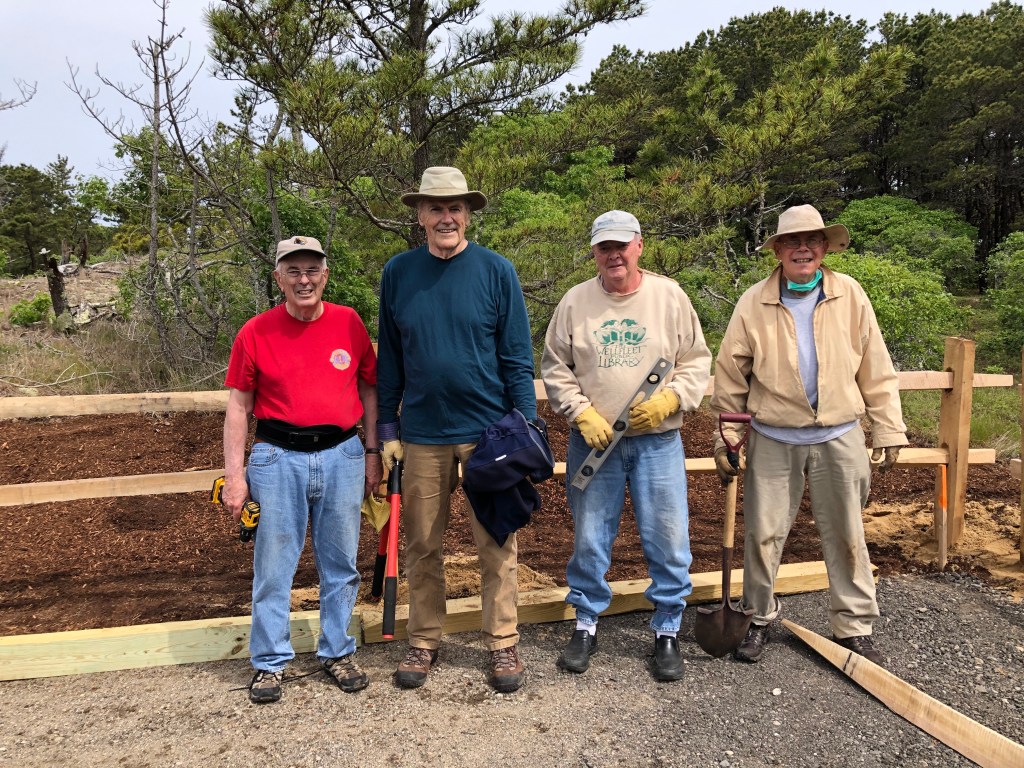
Trustees and friends held a small work party on June 1 to complete the parking area for a trail through the HRO property, clear the trail, and add steps where needed. Fortunately, it was a sunny day with mild temperatures. The photos here give you some idea of the work involved and also what the finished trail will be.

MIke FIsher, Dave Koonce, and Denny O’Connell building a slit rail fence around the parking area
Mike and Dave digging post holes
Americorps worker, Mary Doucette and Barry Turnbull trimming a tree
Denny, Dave, and Mike measuring a post hole
Mike setting steps on a steep area at the start of the trail
Denny, Chip, Dave, and Mike after completing one section of fence