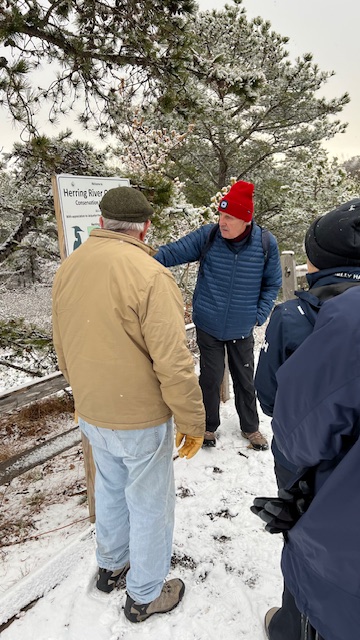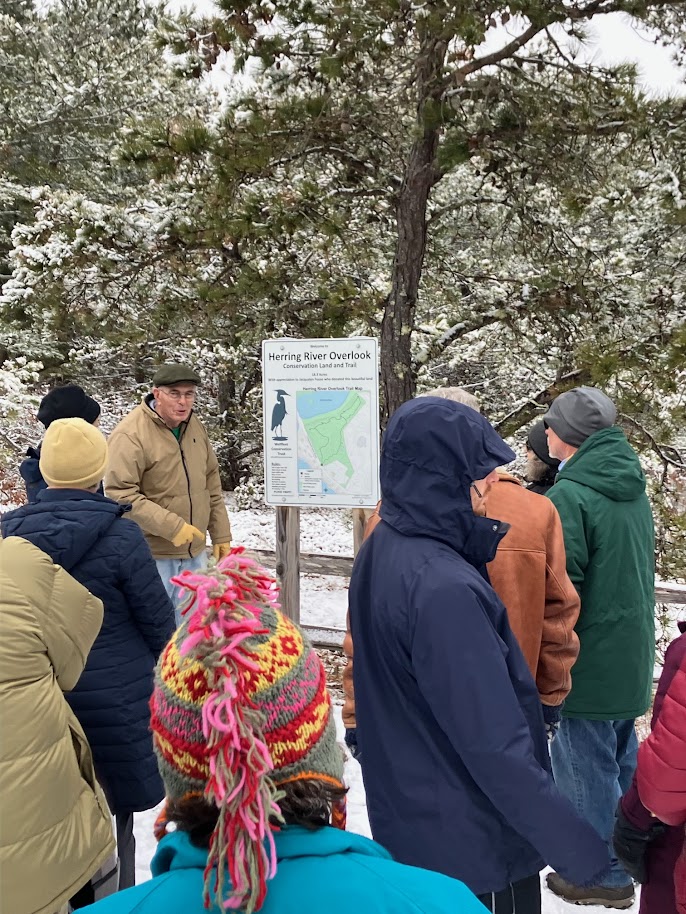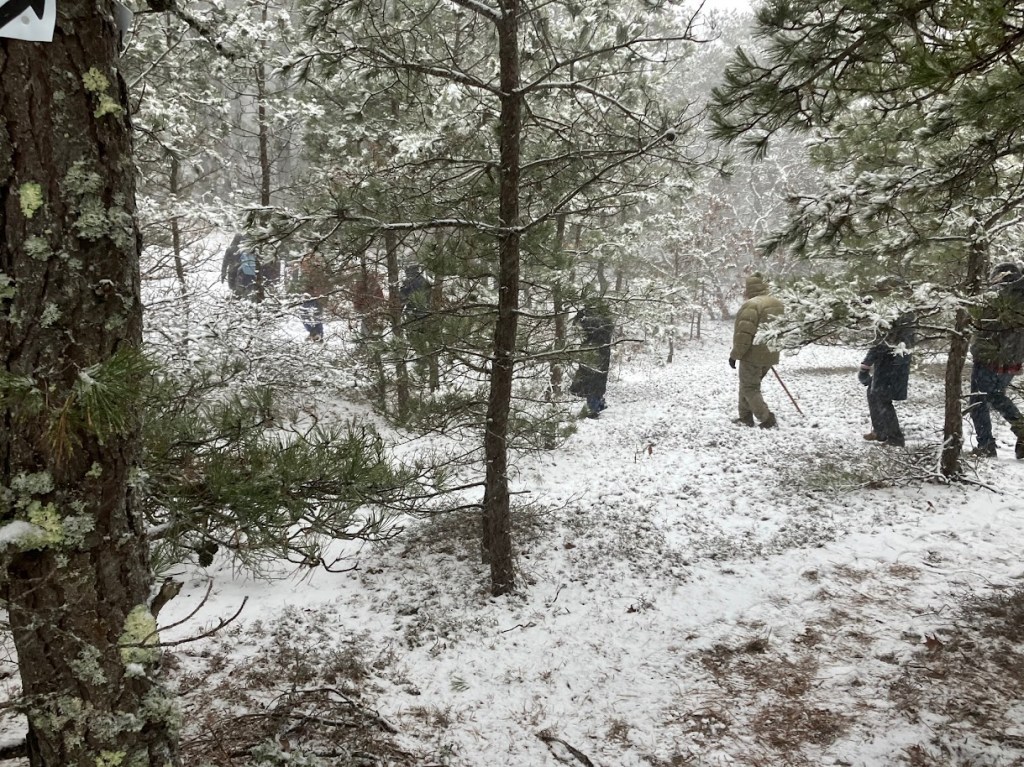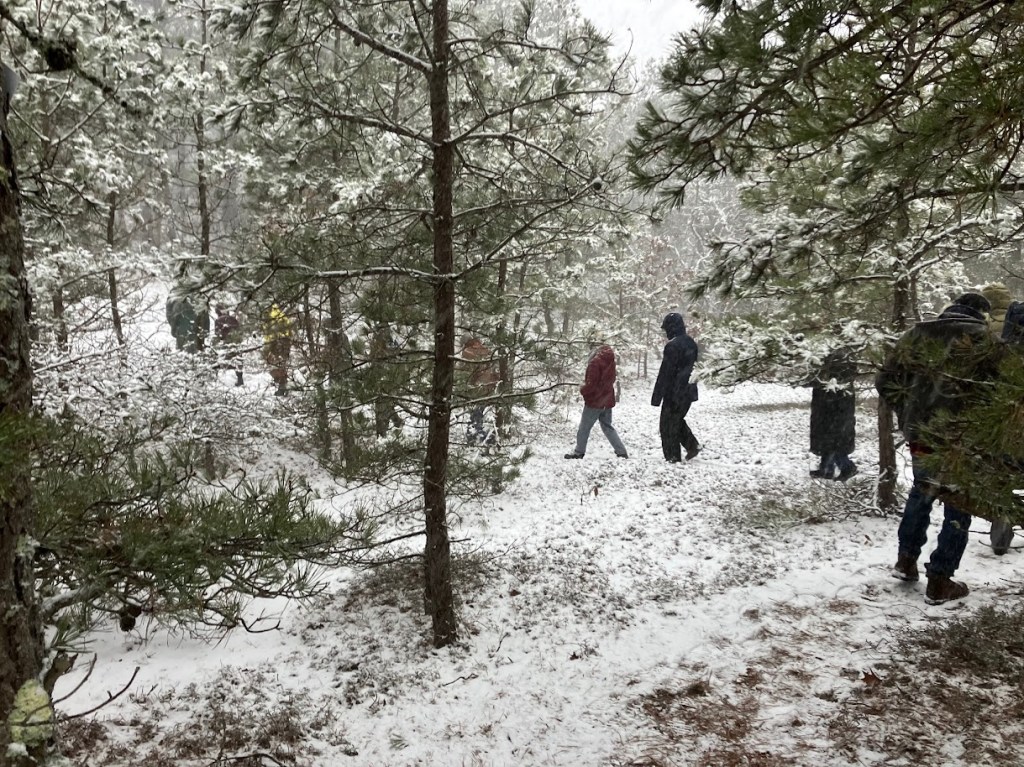
Woodlands, Marsh, Historical District: WCT 15th Annual Guided Walk

Contributors: Mary Rogers,  Mark Robinson, and Dwight Estey.

Editors: Alice & Bill Iacuessa

The 2023 Wellfleet Conservation Trust (WCT) walk was delayed, as were the previous two. As in the 2019 (13th) walk, the weather delayed it by a day. The 2020 walk was delayed two years due to covid and became the 2021 (14th) walk. On a positive note, the weather was warm and sunny for all three.

The plan for the walk

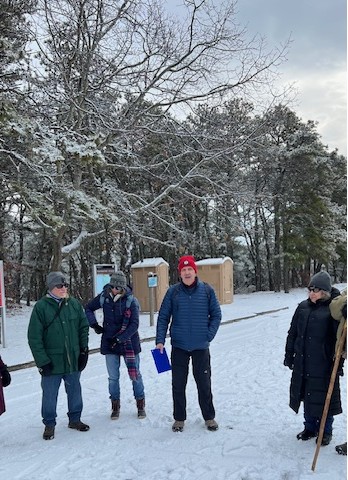
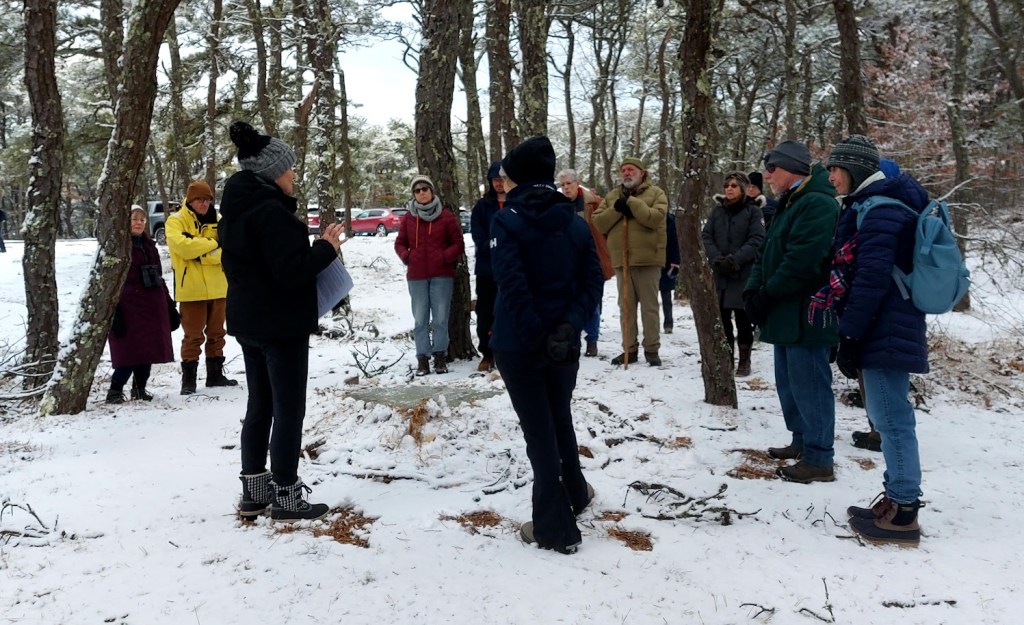
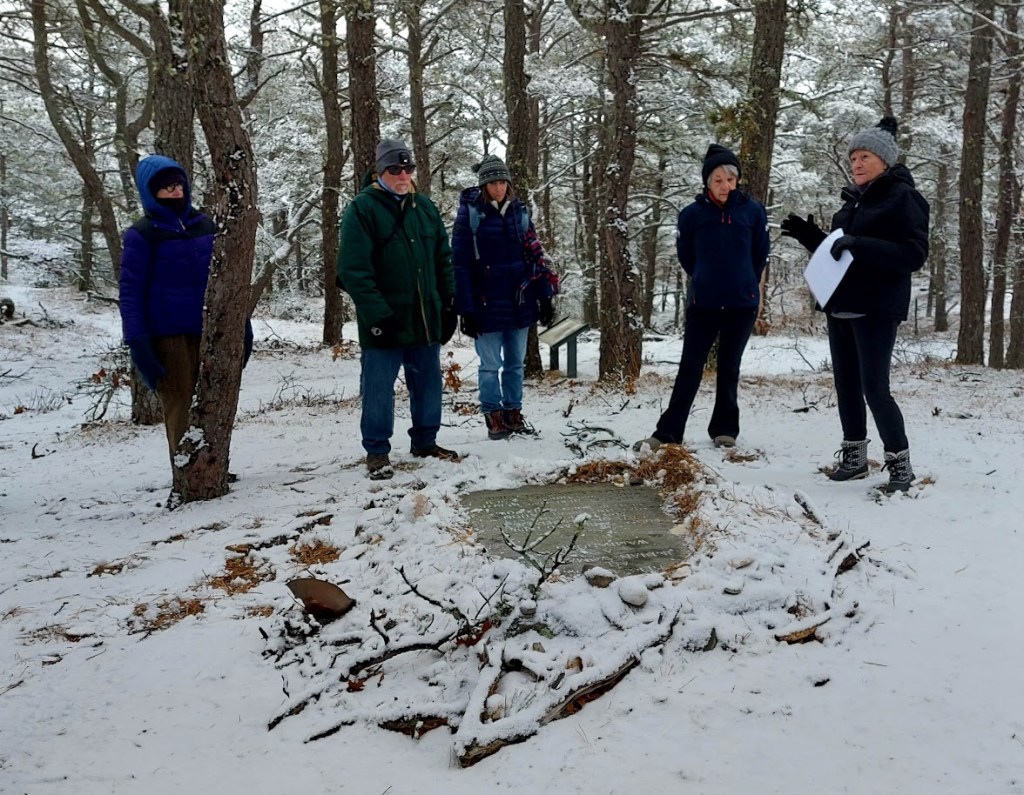
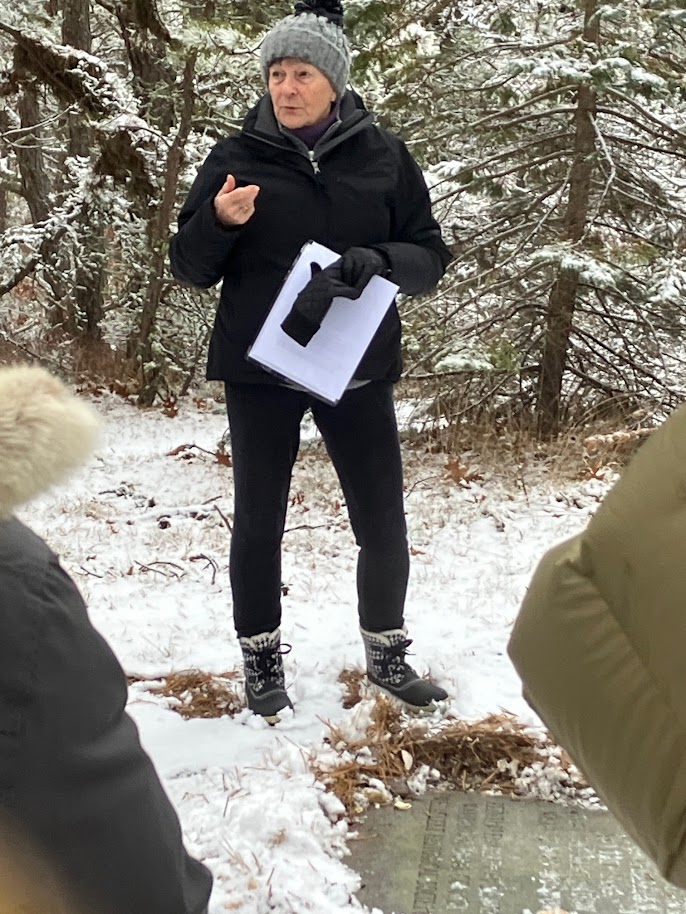
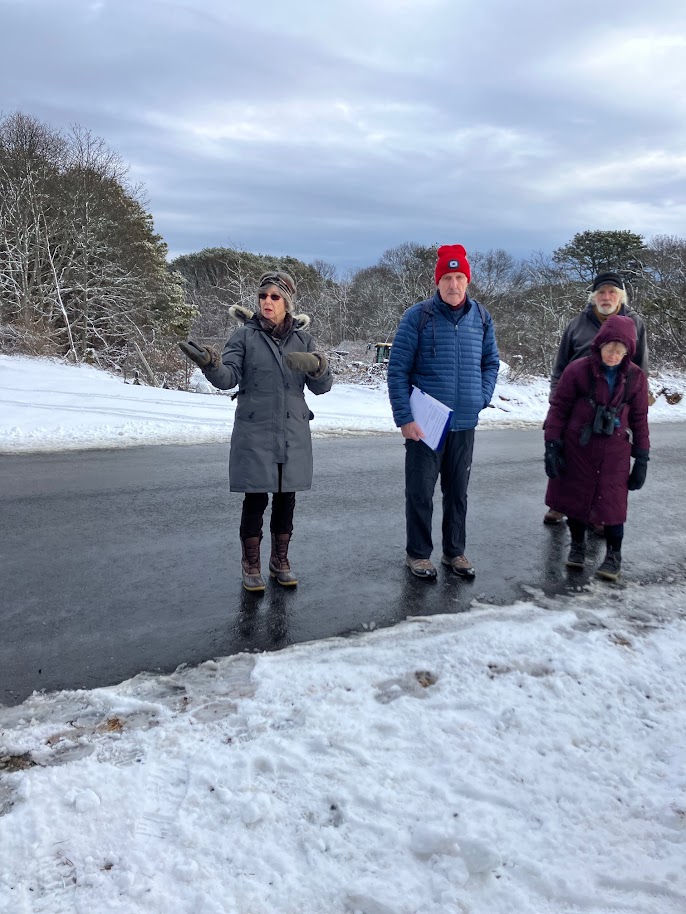
The 2023 walk started in the middle of the Fox Island Marsh and Pilgrim Spring Woodlands Conservation Area. Denny O’Connell, President of WCT, opened the walk at the Robert Hankey Memorial Stone by welcoming the 35 participants. Robert Hankey was a founding member of WCT and was directly involved in the creation of this conservation area.

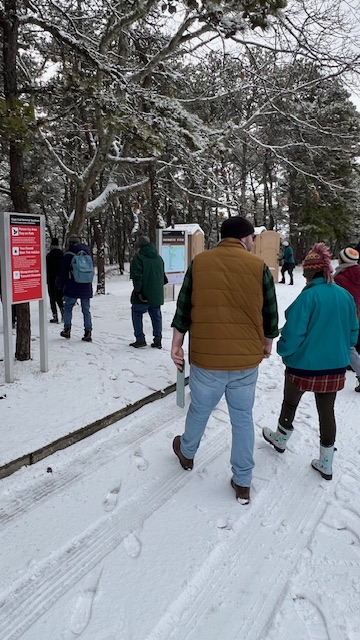
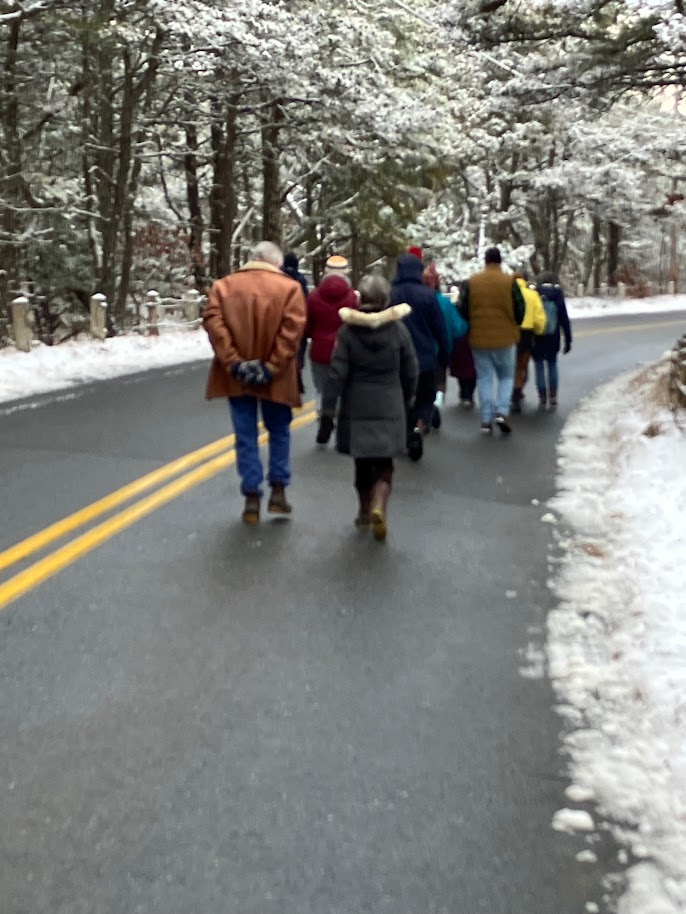
Bill Iacuessa, WCT Vice President and organizer of the walk, explained that the walk would go through three distinct areas, woodlands (mostly along narrow paths), along the edge of a marsh, and finally through an historical area of South Wellfleet.

Speakers

This year, the speakers concentrated on the history of the area. The first stop was at the bench dedicated to the Ira Ziering family. Denny described how instrumental Ira was in helping to acquire a few of the parcels of the area. He also pointed to the Trust’s newest acquisition, the nearby Bouchard property.

Mary Rogers hypothesized on the name of a particular area of the walk, Pilgrim Spring Woodlands. She suggested it could have been the possible location of the natural spring that gave Pilgrim Spring Woodlands its name. She also described the Cape Cod Pilgrim Mineral Spring Company that produced bottled tonic water prior to World War I.

At the edge of Fox Island Marsh, Mark Robinson, Executive Director of the Compact of Cape Cod Conservation Trusts, spoke about how the WCT led the partnership that resulted in the Town, Commonwealth, and private donors raising $4.5 million to acquire 68 acres of upland for conservation. Mark was involved in the negotiations and fundraising including liaising with the Commonwealth. This assemblage is the largest conservation area north of the Orleans rotary and is an important habitat for the endangered Diamondback Terrapin.

Further along the marsh and into the woods, Denny told the story of the burial that took place a number of years ago. It was the burial of a cast iron bath tub that was acquired with the land. Trustees and AmeriCorps members, dug it out of its hole, widened the hole, turned the tub upside down and buried it. Photos of the event were passed around.

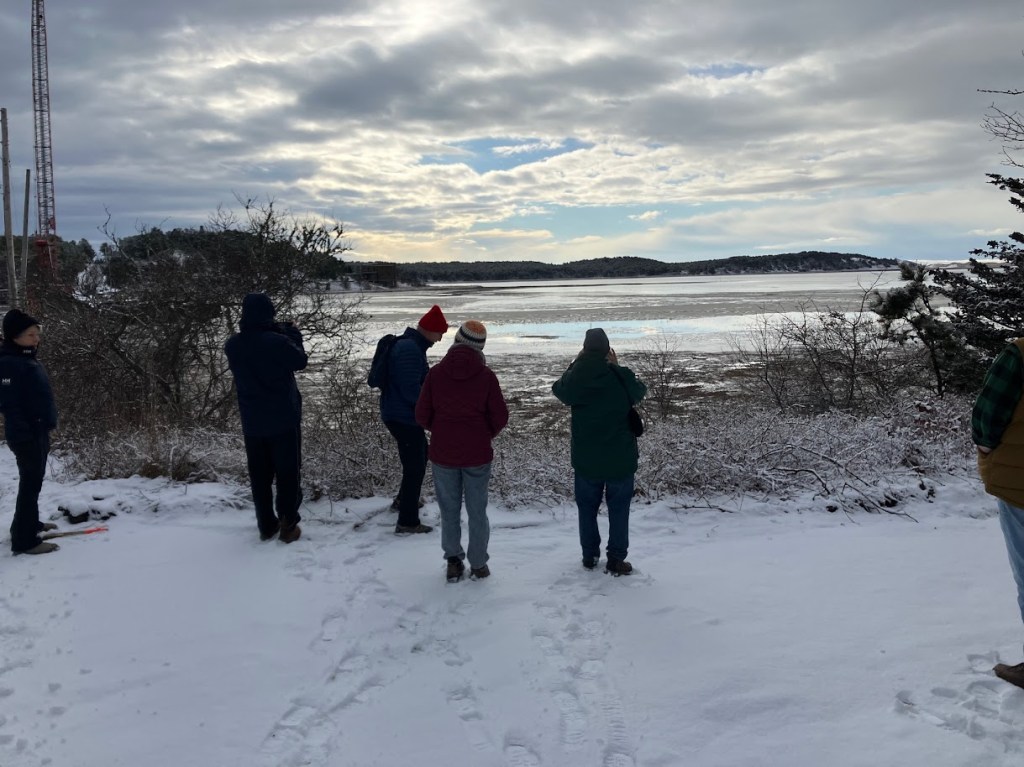
At Whalebone Point. Mark Robinson described the vista that came into view, including Indian Neck, Blackfish Creek, Lt Island, the bridge to the island, and Old Wharf Point.

As always, these walks are a group effort involving a number of our trustees.

Growth of the town

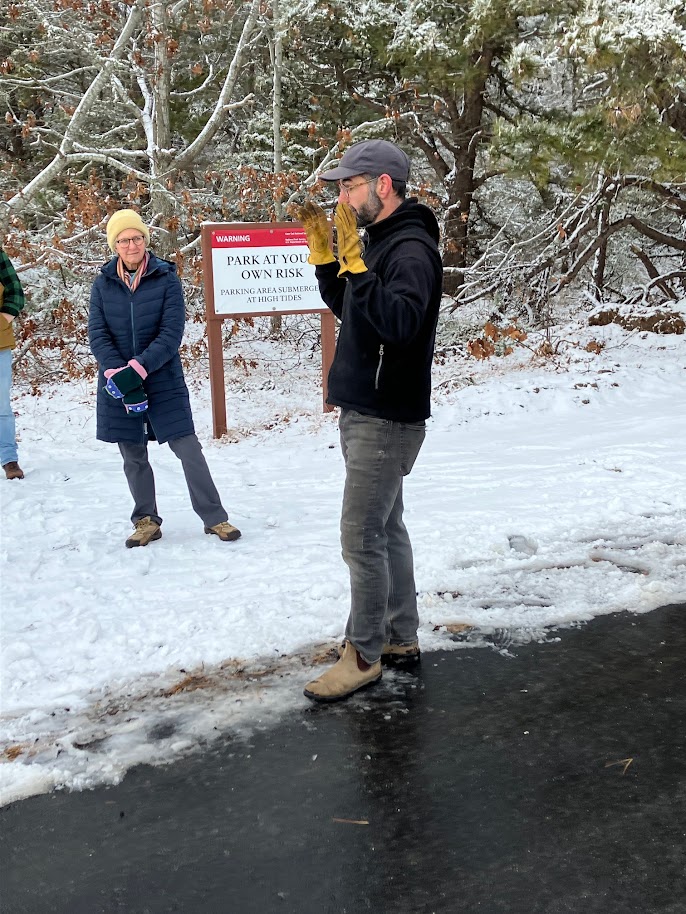
Dwight Estey used two locations to describe the relationship between the growth of the town during the 19th century driven by the mackerel fishery and today’s Paine Hollow Historic District. At Paine Hollow Landing he pointed out the abandoned location of the Southern Wharf at the end of Old Wharf Point and the long-gone Townsend Salt Works which was near where they were standing. The wharf served a few dozen two-masted and three-masted ships primarily used in the mackerel trade. Among its buildings was a salt-shed used for salting down the catch. Overall, from 1820-1850 the town population grew from 1,400 to over 2,400, schools increased from 6-12 and there were up to 100 boats in the mackerel trade.

Moving to the corner of Paine Hollow Road and Pleasant Point Road (formerly known as Hinckley Corner) he referred to Irene Paine’s book, Eva and Henry, as a reference to better understand the area. Prior to 1800 there were scattered houses of the Youngs, Riches, Wiley’s and Lombards – among others.

Within the historical district there are now seven houses associated with the Paines. They were all built in the early 19th century when the Paines were involved in the fishery. The purchase of the Southern Wharf by Collins Cole and Nathan Paine began a long history of both families settling down in this area that is sometimes referred to as “the road that time forgot.”

The contingent was told the tale of Isaac Rich who was born (1801) on Pleasant Point Road. The eldest of ten children, Isaac at age 14 moved to Boston with his father to find employment. Starting by pushing an oyster cart, at age 19 his father died and Isaac opened an oyster stall. Using earning he first invested in ships and then Boston real estate. A devout Methodist, Isaac died in 1872 as one of the richest men in Boston, leaving his entire estate for the founding of Boston University. Though worth 1.5 million when he died, the Great Fire of Boston removed half that worth.

The last site discussed was that of the Robert Young Cemetery. Started in 1799 its last burial was 1854. The stones were moved to the South Wellfleet Cemetery but the bodies were not. Only eight of the stones still exist although over a dozen bodies were buried there.

Can we have both open space and affordable housing?

Seth Rolbein’s latest post, Buying open space, pushing big-lot zoning, provides a straightforward discussion of the need and possibilities for affordable housing on Cape Cod. The loss of affordable housing has transformed daily life, including hollowing out communities, increasing traffic, and endangering health.

Seth shows clearly how the loss of affordable housing was not due to protecting open space for conservation and recreation. Instead, decades of zoning battles that emphasized single-family homes and ever-larger lot sizes drove up costs “and ignored alternatives like more density in well-selected places.”

Land Trust Alliance’s new Resource Center

Herring River Overlook

Last month, the Land Trust Alliance opened its new Resource Center.

It’s described as “a one-stop-shop for volunteers, staff and board members of land trusts and other conservationists to learn, connect and grow.” The Resource Library holds more than 3,000 documents, courses, events and other materials related to land conservation.

There’s too much there to give a detailed summary, but it’s easy to browse. The Library is interesting to explore and can be valuable to anyone interested in conservation.

The Alliance has nearly 950 land trust members across the country, including Wellfleet Conservation Trust. The members are  community-based, nonprofit organizations that work to conserve land by acquisitions or conservation restrictions. They also manage or restore land once it has been conserved.

Annual Walk, September 17, 2022

By Bill Iacuessa

The 14th annual Wellfleet Conservation Trust (WCT) walk was held on Saturday, September 11.  Due to COVID the walk was cancelled twice, so it was 3 years in the planning but well worth the wait.  Denny O’Connell, President of WCT, welcomed the walkers at the Long Pond parking lot.  Bill Iacuessa, organizer of the event, oriented the group to the unpaved roads and trails of the walk which are almost exclusively in the Cape Cod National Seashore. The highlights included Spectacle Pond, Kinnacum Pond and Gross Hill. As usual there were stops and speakers along the way.

Before heading off, Bill passed out photos of the ice house that existed along Long Pond in the late 1800s and early 1900s.  Arriving at Spectacle Pond, John Portnoy, a scientist at the National Seashore for many years, spoke about the geology of Wellfleet ponds and Spectacle Pond in particular. Mary Rogers entertained the group about the quirky ways the names of streets and unpaved roads in town are changed. 

At Kinnacum Pond, David Wright explained the rich life of Dr. David Belding, who built the cottage on the pond.  The cottage is on private land and not normally accessible to the general public.   Dr. Belding was a shellfish biologist and medical doctor.  His work ushered in a century of purposeful aquaculture in Wellfleet, resulting in today’s robust and sustainable system of grants, licensing, propagation and management.

Along Isabell Way, near Gross Hill, Dwight Estey spoke about the lives of the famous Gross sisters, as they came to be known.  Copies of the daguerreotype of the sisters, made in 1851, were passed around.  When taken, the eldest was 85 and the youngest 57.  It would be the only time that the sisters were all together.

The final section of the walk, along a narrow trail, passed by a grove of Tupelos which are known for their beautiful fall foliage.  This grove is on high ground, an unusual site for this tree, which loves a moist, low-lying environment.  The trail also passed by an abandoned foundation whose story is now lost.   It was a perfect day weather wise and over 75 walkers enjoyed the trails and presentations.

Video of New Herring River Overlook Trail

A new video for the Herring River Overlook Conservation Land and Trail has just been released. As with our other videos, thanks go especially to Mary Doucette, advised by Mike Fisher.

The Herring River Overlook Conservation Land and Trail consists of 18+ acre uplands property with a 1 mile trail consisting mainly of a pine-oak woodland. The northwestern portion of the trail offers panoramic views of the Herring River, Griffin and Great Islands and Cape Cod Bay.

Length of Trail & Total Conservation Land Area: 1 miles; 18.3 acres

Area description: This beautiful 18.3 acre uplands property is a typical coastal heath that is succeeding to a pine-oak woodlands. It hosts about a 1 mile walking trail loop which starts and ends at the parking area. In the northwestern stretches, the ridge offers spectacular views of the Herring River, Griffin and Great Islands and into the Cape Cod Bay. Previously the land had been part of the surplus land holdings of the Chequessett Club, known for its golf, sailing and tennis activities. The Trustees of Chequessett Club had a strong preference to see the land in conservation and open to the public. This land has never been inhabited in modern times. Geologically, the land is an outwash plain, a remnant of the last glacial age of approximately 25,000 years ago. The land was graciously donated by Ms. Jacqualyn Fouse, a local resident, to the Wellfleet Conservation Trust in 2020.

Location: The trail head is at 1000 Chequessett Neck Road; GPS 41.92820° N, 70.06226° W

Directions: Exit Route 6 on Main Street; follow to the end of the commercial district; Left on Holbrook Ave; Right on Chequessett Neck Rd.; follow 1.9 miles.

WCT 14th Annual Walk

The Wellfleet Conservation Trust is planning its 14th annual guided walk to take place the morning of 11 September.  The walk will be in the area bounded by Gross Hill Road, Ocean View Drive, and Long Pond Road.  It will be almost exclusively on dirt roads and paths, about 2.4 miles in length with some moderate hills.  We will have short discussions/lectures at points of interest. The walk is FREE to participants and expected to take about 2.5 hours.  Walkers who have not received a Covid vaccination are asked to wear masks since social distancing will not always be possible.

This year, walkers are asked to register in order to participate.   Parking will be at a premium so we encourage carpooling when possible. 

If you wish to attend, please register by sending an email to
wct.annual.walk@gmail.com

Make the Subject:    Registering for WCT Annual Walk

In the Body list:     First and Last Name

Once you have registered, you will receive an email with details on time, parking, and a more detailed description of the walk.

The Annual WCT walk to resume this coming September

Plans have not yet been finalized, but WCT intends to offer the Annual Guided Walk in September.  The target date is Saturday, September 11, and the route will follow dirt roads and trails from Long Pond to Spectacle Pond and back. It should be about a two mile walk.  Timing and parking logistics need more planning, so you will need to follow our website and Facebook page for more details as they become available. 

Herring River Overlook work party

Our newest WCT conservation area, now dubbed Herring River Overlook (HRO), offers woodlands, wetlands, meadows, and incredible views of the Herring River estuary.

As the Herring River restoration project proceeds, these views will become even better. They’ll provide a tutorial on the restoration of the historic salt marsh, with its diverse flora and fauna.

Trustees and friends held a small work party on June 1 to complete the parking area for a trail through the HRO property, clear the trail, and add steps where needed. Fortunately, it was a sunny day with mild temperatures. The photos here give you some idea of the work involved and also what the finished trail will be.

MIke FIsher, Dave Koonce, and Denny O’Connell building a slit rail fence around the parking area
Mike and Dave digging post holes
Americorps worker, Mary Doucette and Barry Turnbull trimming a tree
Denny, Dave, and Mike measuring a post hole
Mike setting steps on a steep area at the start of the trail
Denny, Chip, Dave, and Mike after completing one section of fence

New Drummer Cove video

A new video for the Drummer Cove conservation area has just been released. Thanks go especially to Mary Doucette, advised by Mike Fisher.

The Drummer Cove area is remarkably varied for its 11+ acres. It is also unusual for offering a 1+ mile trail with easy access.
Length & Extent of Trail: 1.1 miles; 11.3 acres plus easements

Area description: The Drummer Cove Conservation Area includes salt marsh, tidal flats, coastal bank and oak pine forest on its upland. The entire area is within the recharge area to Drummer Cove and as such falls into the Wellfleet Harbor Area of Critical Environmental Concern. The land is in State designated Priority Habitat for rare species. The four benches provide great views of the Cove.

Location: The trail head is at 170 Pond Ave in South Wellfleet. 41.91415, -70.00165

Directions: Exit Route 6 heading west for approximately 0.5 miles on Paine Hollow Road to the first stop sign. Turn left on Pleasant Point Road for approximately 0.25 miles. Turn left on to Pond Ave for 0.3 miles, the last part being a dirt road to a parking area at the trail head.