
Contributors: Mary Rogers, Mark Robinson, and Dwight Estey.
Editors: Alice & Bill Iacuessa
The 2023 Wellfleet Conservation Trust (WCT) walk was delayed, as were the previous two. As in the 2019 (13th) walk, the weather delayed it by a day. The 2020 walk was delayed two years due to covid and became the 2021 (14th) walk. On a positive note, the weather was warm and sunny for all three.




The plan for the walk
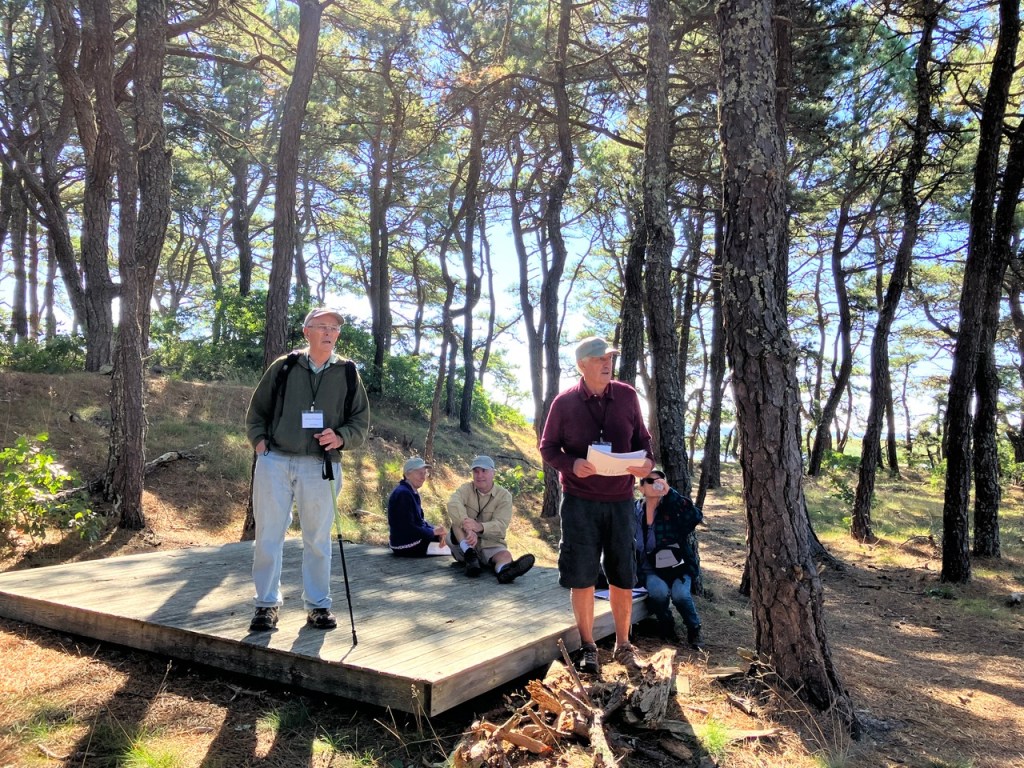
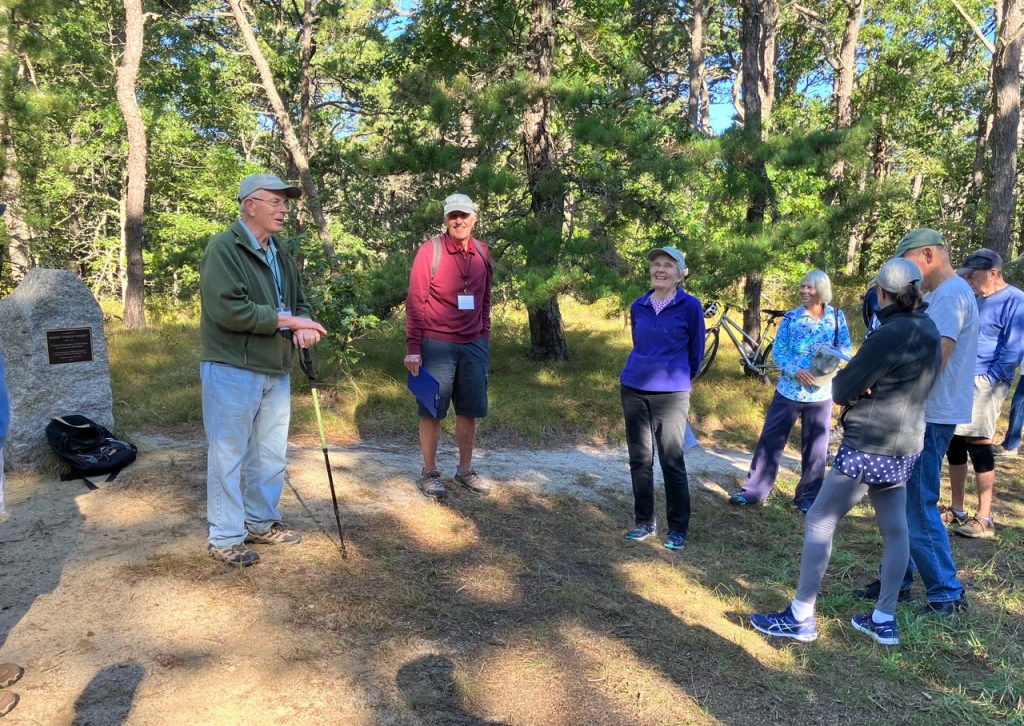
The 2023 walk started in the middle of the Fox Island Marsh and Pilgrim Spring Woodlands Conservation Area. Denny O’Connell, President of WCT, opened the walk at the Robert Hankey Memorial Stone by welcoming the 35 participants. Robert Hankey was a founding member of WCT and was directly involved in the creation of this conservation area.
Bill Iacuessa, WCT Vice President and organizer of the walk, explained that the walk would go through three distinct areas, woodlands (mostly along narrow paths), along the edge of a marsh, and finally through an historical area of South Wellfleet.
Speakers
This year, the speakers concentrated on the history of the area. The first stop was at the bench dedicated to the Ira Ziering family. Denny described how instrumental Ira was in helping to acquire a few of the parcels of the area. He also pointed to the Trust’s newest acquisition, the nearby Bouchard property.
Mary Rogers hypothesized on the name of a particular area of the walk, Pilgrim Spring Woodlands. She suggested it could have been the possible location of the natural spring that gave Pilgrim Spring Woodlands its name. She also described the Cape Cod Pilgrim Mineral Spring Company that produced bottled tonic water prior to World War I.
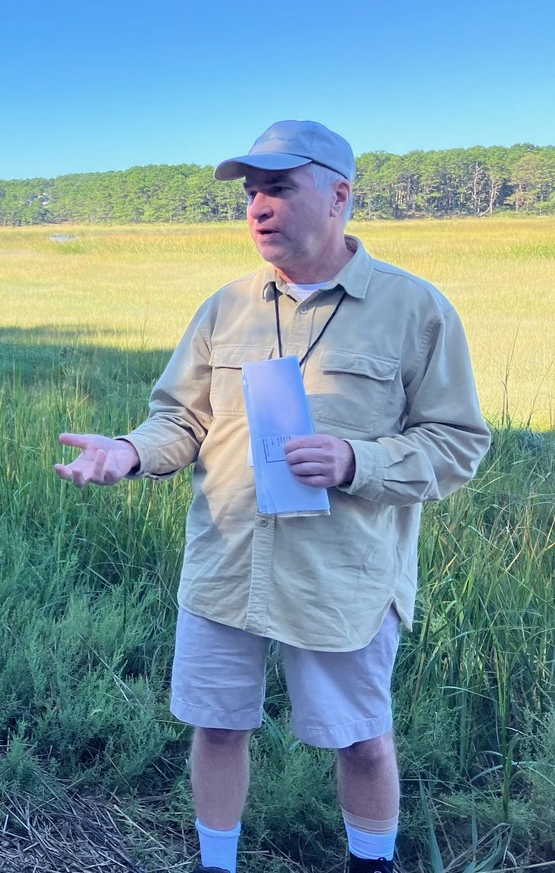
At the edge of Fox Island Marsh, Mark Robinson, Executive Director of the Compact of Cape Cod Conservation Trusts, spoke about how the WCT led the partnership that resulted in the Town, Commonwealth, and private donors raising $4.5 million to acquire 68 acres of upland for conservation. Mark was involved in the negotiations and fundraising including liaising with the Commonwealth. This assemblage is the largest conservation area north of the Orleans rotary and is an important habitat for the endangered Diamondback Terrapin.
Further along the marsh and into the woods, Denny told the story of the burial that took place a number of years ago. It was the burial of a cast iron bath tub that was acquired with the land. Trustees and AmeriCorps members, dug it out of its hole, widened the hole, turned the tub upside down and buried it. Photos of the event were passed around.
At Whalebone Point. Mark Robinson described the vista that came into view, including Indian Neck, Blackfish Creek, Lt Island, the bridge to the island, and Old Wharf Point.
As always, these walks are a group effort involving a number of our trustees.
Growth of the town
Dwight Estey used two locations to describe the relationship between the growth of the town during the 19th century driven by the mackerel fishery and today’s Paine Hollow Historic District. At Paine Hollow Landing he pointed out the abandoned location of the Southern Wharf at the end of Old Wharf Point and the long-gone Townsend Salt Works which was near where they were standing. The wharf served a few dozen two-masted and three-masted ships primarily used in the mackerel trade. Among its buildings was a salt-shed used for salting down the catch. Overall, from 1820-1850 the town population grew from 1,400 to over 2,400, schools increased from 6-12 and there were up to 100 boats in the mackerel trade.
Moving to the corner of Paine Hollow Road and Pleasant Point Road (formerly known as Hinckley Corner) he referred to Irene Paine’s book, Eva and Henry, as a reference to better understand the area. Prior to 1800 there were scattered houses of the Youngs, Riches, Wiley’s and Lombards – among others.
Within the historical district there are now seven houses associated with the Paines. They were all built in the early 19th century when the Paines were involved in the fishery. The purchase of the Southern Wharf by Collins Cole and Nathan Paine began a long history of both families settling down in this area that is sometimes referred to as “the road that time forgot.”
The contingent was told the tale of Isaac Rich who was born (1801) on Pleasant Point Road. The eldest of ten children, Isaac at age 14 moved to Boston with his father to find employment. Starting by pushing an oyster cart, at age 19 his father died and Isaac opened an oyster stall. Using earning he first invested in ships and then Boston real estate. A devout Methodist, Isaac died in 1872 as one of the richest men in Boston, leaving his entire estate for the founding of Boston University. Though worth 1.5 million when he died, the Great Fire of Boston removed half that worth.
The last site discussed was that of the Robert Young Cemetery. Started in 1799 its last burial was 1854. The stones were moved to the South Wellfleet Cemetery but the bodies were not. Only eight of the stones still exist although over a dozen bodies were buried there.

 Wellfleet Conservation Trust
You must be logged in to post a comment.